I have taught introductory and upper-level classes in both physics and astronomy, for majors and nonmajors, as well as a pedagogy course for new astronomy PhD students. All of my classes are designed around the principles of practical experience, Universal Design, and active learning.
I am currently a Visiting Assistant Professor at Swarthmore College, where I teach introductory mechanics (PHYS 003), sophomore stellar astrophysics (ASTR 016), and an upper-level galaxies seminar (ASTR 128), along with the introductory physics and astronomy labs. Before Swarthmore I taught at Juniata College and Colby College.
Brian DiGiorgio Zanger
Courses Taught
As instructor of record, unless noted otherwise.
| Course | Institution | Terms |
|---|---|---|
| Introductory Physics: Mechanics (PHYS 003) | Swarthmore | Fall 2026 |
| Stars, ISM, and Galaxies (ASTR 016 / AS231) | Swarthmore, Colby | Fall 2026, Fall 2025, Fall 2023 |
| Galaxies & Galactic Structure (ASTR 128 / AS342) | Swarthmore, Colby | Spring 2026, Spring 2024 |
| Introductory Physics Lab (PHYS 003/004, PC202L) | Swarthmore, Juniata | Fall 2025, Fall 2024 |
| Introductory Astronomy Lab (ASTR 001) | Swarthmore | Fall 2026, Fall 2025 |
| First-Year Seminar: Are We Alone? (FYS 102) | Juniata | Spring 2025 |
| Introductory Astronomy (AS160, AS151, ASTR 2) | Juniata, Colby, UCSC | Spring 2025, Spring 2024, Summer 2022 |
| Modern Physics (PC301) | Juniata | Fall 2024 |
| Introduction to Scientific Computing (PH398) | Colby | Spring 2024 |
| Extraterrestrial Life (AS172) | Colby | Fall 2023 |
| Intro. to Astronomy Research & Teaching (ASTR 205) | UCSC | Fall 2022, Fall 2019 |
| Teaching assistant, four undergraduate courses | UCSC | 2017–2023 |
Introductory Classes
 Since few students in introductory classes ever expect to take any other astronomy classes, I choose to focus my curriculum more on practical astronomy rather than academic astronomy. One of my main goals was that the students be able to point out something cool in the night sky, so I give regular stargazing assignments to encourage students to become familiar with the stars, planets, and constellations. When course conditions permit, I also supplement these assignments with outdoor sessions to apply stargazing concepts we discussed in class in a real night sky environment.
Another of my goals is to provide enough background to allow students to engage closely with astronomy news they encountered. The academic astronomy content I present is geared towards the subjects that are often written about in the media, giving them the tools to evaluate the articles they found on those subjects, and one of my final project options allows them to apply these skills.
My homework assignments and worksheets emphasize knowledge transfer between different topics in the class, connecting different units that share common concepts. I also encourage students to learn from their mistakes by allowing them to resubmit their old homework assignments after correcting their work.
I have also taught "Extraterrestrial Life," an astrobiology-flavored introductory astronomy course. Beyond the usual introductory astronomy topics, this class also covers planetary science, geology, molecular biology, and philosophy, all with the goal of estimating each term in the Drake Equation to figure out how much life there is in our galaxy. At Juniata I adapted this material into "Are We Alone?", a discussion-based first-year seminar with a writing and literary analysis component to meet the college's liberal arts requirements.
Introductory Physics
Introductory mechanics is the course where most students decide whether physics is something they can do, so I treat it as a course about modeling rather than memorization. I tell my students that studying physics is like getting a degree in word problems, and I am only half joking: the skill I am actually teaching is how to strip a messy real-world situation down to something solvable, predict what the answer should look like, and then check whether the answer you got makes sense.
My Swarthmore mechanics section has about 75 students. Mondays and Wednesdays are for content delivery, and Fridays are given over entirely to group problem solving, with the course assistants and me circulating. Each week students write down one concrete way they contributed to the learning of the class as a whole, which is how participation is assessed — it rewards the students who help their neighbors rather than the ones who talk the most.
I also run the accompanying inquiry-based labs for both the mechanics and E&M sequences. At Juniata I rebuilt the introductory lab curriculum around new Vernier sensors and software, rewriting the lab manuals to match.
Advanced Classes
While I keep all of my same course policies for advanced classes, upper-level students, many of whom are declared physics or astronomy majors, require increased expectations. One essential skill for a physicist or astronomer is the ability to convey their ideas clearly and professionally, so I place great importance on the quality of writeups, incentivizing students to turn in well-crafted solution sets rather than hastily-written answer sheets. I give students example writeups to base their work on, increasing the value of presentation throughout the class to allow them to learn in a low-stakes environment before applying their knowledge.
My upper level assessments are also meant to mimic the environment of professional physicists and astronomers, who must answer off-the-wall audience questions at talks far more often than they solve contrived problems in a closed-note written environment. I give oral exams to my students, giving them a chance to show the depth of their comprehension in real time and giving me the opportunity to evaluate their learning and expertise holistically.
I have used oral exams across three institutions: in two upper-level astronomy electives at Colby, in Modern Physics at Juniata, and in both Stellar Astrophysics and the Galaxies seminar at Swarthmore. Writing up what I learned from those five iterations became my American Journal of Physics paper below.
Pedagogical Publications
I have written two peer-reviewed articles on physics education.
"Using oral exams in physics and astronomy courses" describes the oral exam method I use in upper-level courses for majors. Traditional oral exams have a well-earned reputation for bias, so the method uses a rigid question structure and an explicit grading rubric to standardize evaluation while still assessing students in the format they will actually face as scientists. Students in the courses where I have used them have reported more confidence in their oral communication and their real-time problem solving. The paper appeared in the American Journal of Physics in March 2026 and was selected as an Editor's Pick.
"Using video games to teach Kepler's laws and orbital dynamics" is about using Kerbal Space Program to teach orbital mechanics in introductory astronomy. The game simulates orbits accurately enough that students can build real intuition for Kepler's laws through in-class demonstrations and a semester-long project. The paper has been accepted by The Physics Teacher. I presented this work at the AAPT summer meeting in Washington, DC in August 2025.
Universal Design for Learning
 I follow the framework of Universal Design for Learning to make my courses as accessible as possible to all different kinds of learners. Using what I learned as a Graduate Pedagogy Fellow at UCSC's Teaching & Learning Center, I write course policies that avoid placing extra burden on students who need accommodations. In practice that means things like a standing 72-hour grace period on assignments and resubmission for full credit on corrected work. These policies are available to everyone, no request required, and I rarely have to change my course policies in response to accommodation requests.
I have continued this training since: I completed UCSC's Summer Course Design & Delivery program on equitable syllabi and assessment, and in August 2025 I attended the AAPT Faculty Teaching Institute workshop on active and accessible course design.
Active Learning
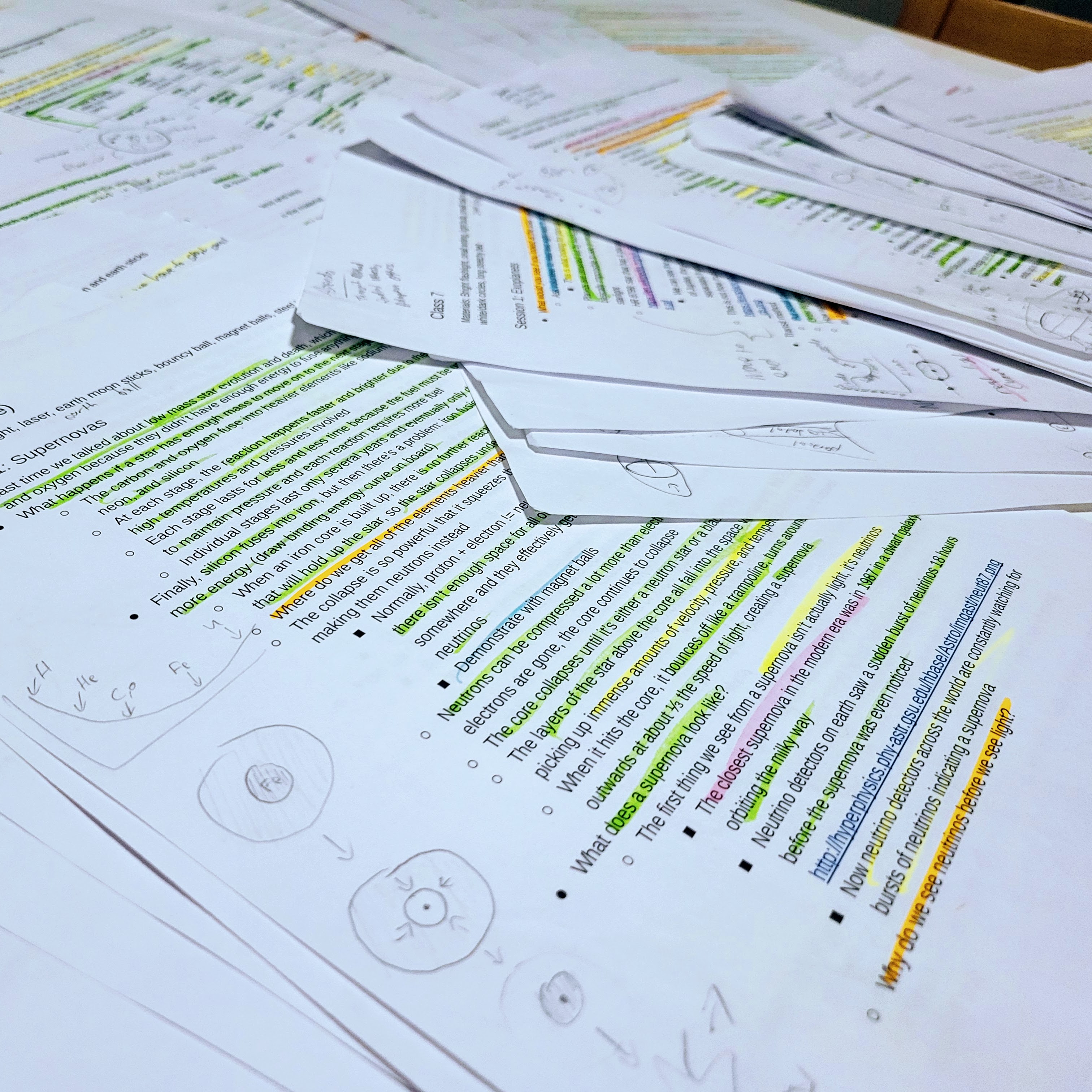
I base my classes on the concept of active learning, doing everything I can to center the content on the student rather than the lecturer. In my introductory astronomy class, I planned worksheets and physics demonstrations for every class day so that students had opportunities to experience the material for themselves and apply their knowledge in real time.
I also assign final projects that let students engage with astronomy concepts in ways that appeal to their personal interests. From journalism to video games to creative work, students can explore astronomy from whatever angle resonates with them the most.
For my graduate pedagogy classes, I center the course around projects for applying teaching concepts in environments similar to a real classroom. Students design and deliver lesson plans, worksheets, and lectures to the class and receive real-time feedback to improve their teaching.
Other Teaching Experience
- Head TA: I served as the Head Teaching Assistant for the astronomy department for the 2019-2020 and 2022-2023 school years. In this position, I settled disputes between professors and their TAs, mediated between the department and TAs during a university-wide strike, and helped professors and TAs transition to online learning at the beginning of quarantine.
- Graduate pedagogy course: I designed and taught ASTR 205, a course for incoming astronomy PhD students on how to teach. The curriculum is built on active learning, Universal Design, and hands-on practice: students write and deliver lesson plans, worksheets, and short lectures to the class and get real-time feedback on them.
- Teaching service and recognition: I received the UCSC Astronomy Department's Excellence in Teaching Award for 2021-22, an annual award for a graduate student showing "an exceptional talent for and interest in teaching." I currently serve on the Physics & Astronomy DEI committee at Swarthmore and with the AAPT South-Eastern Pennsylvania Section, and I review manuscripts for The Physics Teacher and the American Journal of Physics.
- Scientific Computing in Python: I designed and taught a class on modern techniques for modeling scientific data. I created iPython notebooks for teaching concepts in loading and cleaning data, fitting models, and Bayesian statistics in an interdisciplinary project-oriented class. This was based on earlier lessons I made for the Lamat Summer REU at UCSC.
- Astronomy Department TA: I served as a teaching assistant for undergraduate classes at UCSC. I led mandatory TA sections using the principles of active learning, creating worksheets for students to complete in groups and discussing the answers as a class. I also TAed for an upper level class on stars, leading optional homework help sections.